Showing posts with label Cummington. Show all posts

Tuesday, March 9, 2021

Sugaring


There comes a time every year in late February or early March when the sun has climbed to a certain point in the sky, the temperature has risen enough to soften some of the snow and ice--and perhaps even create a bit of runoff alongside the road where the ground slopes downhill--and the smell of mud is in the air. When I step outside on a morning like that I immediately say to myself: "It feels like sugaring weather."

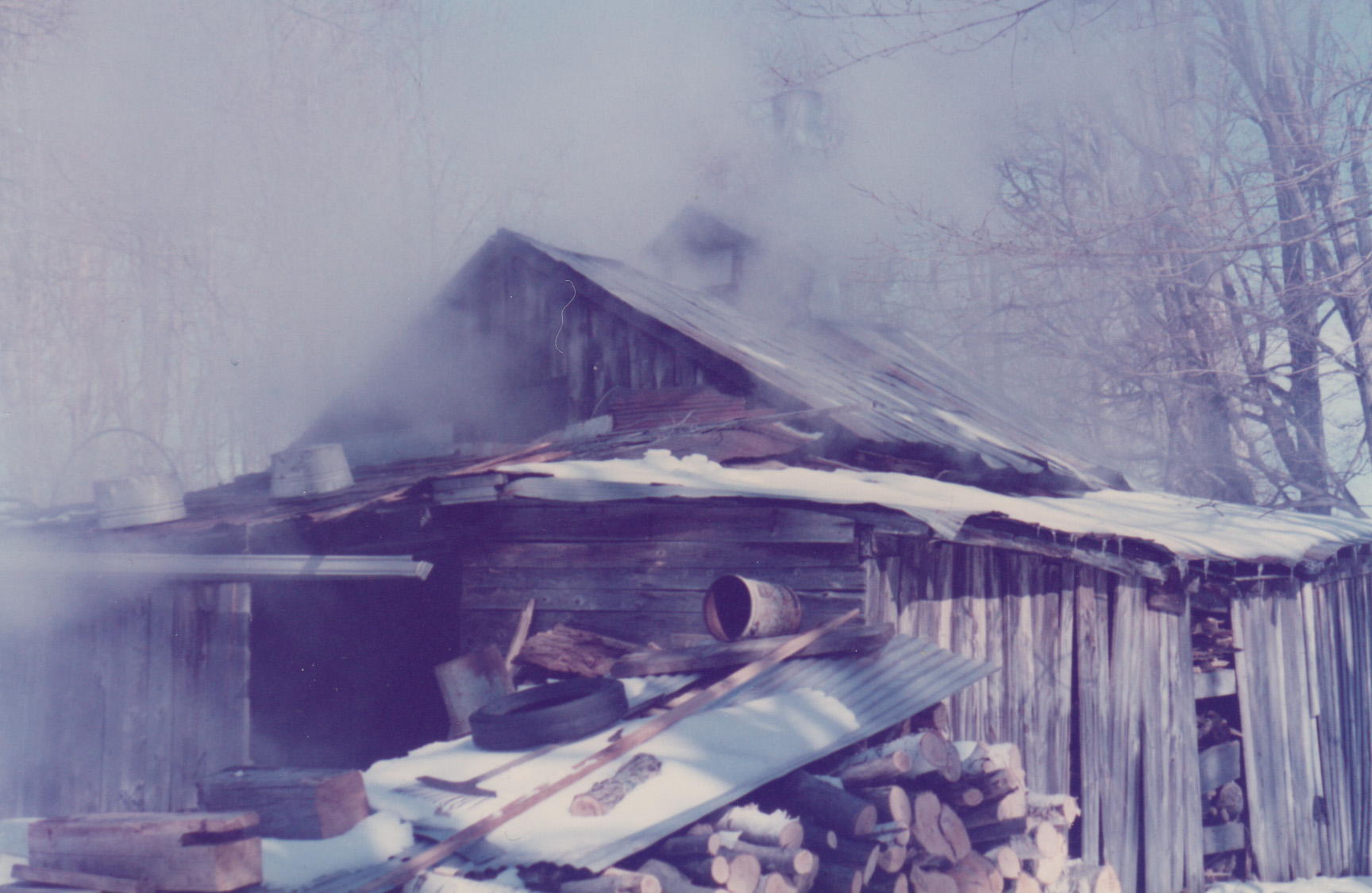
As I write, the maple sugaring season in New England is well underway. I grew up on a farm in western Massachusetts where making maple syrup was a regular and important part of the year's work. It was a time that we all looked forward to for various reasons, even though it meant a lot of hard work. Ours was a small, family operation (about 1,200 taps) that remained largely low-tech throughout the ±125 years that five generations of my family made syrup there. My father, Francis (seen here stoking the fire in the evaporator), was highly-respected among his peers. He was an honorary Lifetime Member of the Massachusetts Maple Producers Association. In addition to passing along love and knowledge of the craft to his children and grandchildren, he served as a mentor to numerous aspiring sugarmakers who came to him for advice and guidance. He was one of the sugarmakers chosen to represent Mass Maple at the 1988 Smithsonian Festival of American Folklife when Massachusetts was a featured state. 

I spent much of my early adulthood living in California so was not able to take part in sugaring for many years. In the early 1980s my first wife, young son, and I moved back to the farm. During the two years we lived there I took a much more active role in the sugaring operation than I had as a kid. During this period I was also trying to establish myself as a freelance writer, an endeavor that had more than its share of frustrations. I wrote the following short piece at a time when the frustrations were winning the day and my confidence was at a low ebb. I submitted it to the Berkshire Sampler, the weekly magazine associated with the Berkshire Eagle newspaper in Pittsfield, Massachusetts, for consideration for their "Dropping In" feature of reader submissions. The fact that it was accepted, and generated some good feedback among readers--one person who read it said that it made his hands hurt!--was worth far more to me than the twenty bucks I got paid for it. I've always been kind of proud of it as a piece of descriptive writing so I thought I'd send it out into the world again.

§§§§§

One night in late March, 1985

It's pushing 11:00 p.m. and I'm in the sugarhouse waiting to finish off one final batch of syrup before calling it quits for the night. Outside, the temperature feels as though it has dropped back below freezing, and the wind has come up.

Inside the sugarhouse, though, the heat of the fire in the evaporator has long since forced me to abandon my heavy wool shirt and I work with just a vest over a long underwear top. The intensity of the heat when I stoke the fire has melted the polypropylene fabric on the wrists of my shirt in spite of the long gauntlets on the heavy leather gloves I wear. Sticky patches of dried-on syrup cover my pants and shoes. The syrup forms an outer crust on top of the mud on my feet.


My hands suffer from a multitude of ills: slivers from the rough slabs used for firewood, steam burns from reaching over the boiling sap, cuts and bruises from sources too numerous to recall, dirt ground in so completely that no amount of scrubbing will get it out, and extreme chapping from being in and out of cold sap, warm water, and freezing snow all day.

The day in this case began some fifteen hours ago and is not over yet. Not every work day during sugaring season is this long, but neither is this an extraordinarily long one. The strain of doing five or six tasks simultaneously, while dealing with tourists, and staying one step ahead of the volunteer help offered by various folks whose eagerness to take part outstrips their familiarity with the process, has made me extremely weary. There is a particular type of exhaustion brought on by spending long periods of time in front of a raging fire. You feel parched, light-headed, thoroughly drained of energy. A night's sleep does not necessarily take the feeling away. 

The sugaring season is in the home stretch. Some of the less optimistic of the local maple sages are already proclaiming it to be over. My reactions to such pronouncements are decidedly mixed; we've reached only 75% of our production goal, but my enthusiasm is shrinking along with the woodpile. 

The weekend has, in any event, been a good one. Probably every other sugarhouse in the Hilltowns is in operation tonight, and all my friends are no doubt feeling pretty much the same way I am. And, just as I'm certain that the syrup I'm boiling is sweet, I know that the first sugarmaker I talk with about the weekend will have worked a longer day, boiled more sap, made more syrup, burned more wood, and talked with more tourists than me. Guaranteed.

Make no mistake, sugaring is a lot of hard work, though it has its romantic aspects and everyone who sugars does so because they love it. There are few other sensations on earth as pleasant as walking into a sugarhouse where the sap is at a full, roiling boil, the room is filled with steam, and the sweet aroma of syrup-in-the-making fills your senses. 

The near-universal replacement of buckets with plastic tubing (which I am in the process of setting out in the photo, complete with a spout in my mouth) as a means of sap collection has eliminated the worst of sugaring's manual labor--you haven't lived until you've broken through the snow crust while carrying a 5-gallon pail of cold sap in each hand and have half of it go down inside your boots--but sugarmakers earn every penny of the $20 they get for a gallon of syrup. [n.b. 1985 price!]

 ---
As the final batch of syrup nears completion I quit stoking the fire in preparation for shutting things down for the night. Once the fire simmers down, the temperature inside the sugarhouse begins to reach equilibrium with that outside. I put back on a couple of the layers of clothing I'd peeled off hours earlier. 

When the syrup is ready, I draw it out of the evaporator into a pail, then pour it into the filter that sits on top of the canner. While trying to adjust the heavy felt filter to make use of a clean area, I lose my grip on the material. A gallon and a half of unfiltered syrup spills into the bottom of the canner, mixing with that which had already passed through. I have to draw off the entire contents from the canner, set up a clean filter, and run the whole batch through again.

That accomplished, I check the fire one last time, gather up the dirty filters to take to the house for washing, turn out the lights, and step outside. The night is clear and cold. The moon is only two days old so the stars shine brightly, with little competition. The distant "Who cooks for you?" call of a Barred Owl accompanies me on my short walk to the house.

In the kitchen I grab a beer from the refrigerator--stoking the fire is dehydrating work--and head to bed, trying not to wake anyone. I chug about half the beer which further numbs my already dulled senses. I take a quick shower--an absolute must--and crawl into bed. I unwind with the rest of my beer and a page or two of a mystery novel.

It's well after midnight when I turn out the light. I drift off, wondering if the sap will run again tomorrow. I'm asleep in less than a minute.

§§§§§

In sugar-camps, when south and warm the winds of March are blowing,
And sweetly from its thawing veins, the maple's blood is flowing.
                                                                --John Greenleaf Whittier, "Among the Hills" (1868)

Currier & Ives, "American Forest Scene - Maple Sugaring"

§§§§§

I've always thought there should be fiddle tunes about maple sugaring so I finally wrote one. I composed this during a period when I was spending a lot of time looking at 19th century tunebooks from New England--Ryan's Mammoth Collection, Howe's School for the Violin, and the like--and I thought I'd try to write a tune that was stylistically similar to the ones in them. "Leather Apron" is an old-time term for the result of a simple test sugarmakers sometimes use to determine if syrup is ready to be drawn off. You scoop a dipper full of syrup out of the evaporator as it is boiling, then tilt the dipper so the liquid drips slowly off the edge, back into the pan. If it comes off in a sheet--i.e., a "leather apron"--rather than in droplets, it is nearly ready. (Click on the tune for a larger image.)

Sunday, January 13, 2019

Handel in the Hilltowns: "Messiah" as an Exercise in Community Music-making

On the last Sunday of December we traveled to my hometown of Cummington, Massachusetts, to participate in the 54th annual sing-through of George Frideric Handel's popular oratorio, Messiah. The sing is always held on the first Sunday after Christmas in the Village Church on Main Street in town. The deal here, for those unfamiliar with the concept of a Messiah sing, is that it is not a performance, but rather an exercise in participatory, informal music-making. Professional, or quasi-professional, vocal soloists are engaged to sing the recitatives and arias, and a pro conductor leads the proceedings. But all the singers in the chorus and all the instrumentalists are folks who just show up and sight-read through the score. They don't tackle the entirety of Handel's work, but do all of Part One (that deals with the Nativity) and selected arias and choruses from Parts Two and Three. Hey, ya gotta do "The Trumpet Shall Sound" (from Part Three), and end the proceedings with the "Hallelujah" chorus (from Part Two)! In spite of it not really being a performance, there is always a small audience of appreciative folks who come just to listen and enjoy.

This was our fourth straight year of traveling from our home in southern Maine in order to take part. Cummington is in the western part of Massachusetts, roughly equidistant from the borders of Vermont, New York, and Connecticut. It is one of the towns that comprise the somewhat loosely-defined area known as the Hilltowns, that includes communities in parts of Hampshire, Berkshire, Hampden, and Franklin counties. All the Hilltowns are small, with populations in the range of 1,000-2,500 people. Historically, the demographic make-up of the Hilltowns has consisted primarily of folks of old Yankee stock -- farmers, tradesmen, loggers, practitioners of other blue-collar jobs -- but it is an area that also has nurtured a fair share of folks engaged in more creative and intellectual pursuits.

Bryant's birthplace in Cummington
Cummington in particular has produced or attracted a good many artists, poets, musicians, and writers over the years. The town's most famous native son was William Cullen Bryant (1794-1878), poet and long-time editor of the New York Post. More recently, Richard Wilbur (1921-2017), one of the most esteemed American poets of the 20th century, made his home there. Many young musicians have spent productive summers honing their skills at Greenwood Music Camp, established in Cummington in 1940. During my youth, the now-defunct Cummington School of the Arts (later: ...Community...) provided a congenial environment for mature artists and musicians to immerse themselves in their craft for a month or so.

Though the arts are by no means the defining cultural strain in town, the strong, long-standing presence and acceptance of art and music in the community has permitted an event like the annual Messiah sing to exist as a tradition for over half a century. But I get ahead of myself...

It is about a four-hour drive from our home in southern Maine to Cummington. When we go there for the Messiah sing we always work in some visits with family members in the area, and celebrate our January 1st wedding anniversary with a nice dinner in Northampton or Amherst (where we spend a night) in order to make the trek worthwhile. This year we enjoyed nice weather and hassle-free traveling in both directions.

We got to Cummington far enough in advance of the 4:00 p.m. start time of the sing to spend a couple of hours catching up with cousins at the family farm before heading to the church. There's always a strong turnout for the sing and parking around the church can get tight, so an early arrival is warranted. We were delighted to snag a spot right behind the building. The back door leads directly to the church kitchen and on into the vestry, where preparations for the post-sing reception were already in full swing.

We threaded our way through the group of busy workers, stopped briefly to exchange some pleasantries with old friends, then staked out good spots in the singers' areas in the sanctuary--Sally with the altos, me with the basses. We visited a bit with our section neighbors while the place began to fill up. Most of those around me were long-time veterans of Cummington Messiah sings. I was pleased to make the acquaintance of a man several years my senior from the neighboring town of Plainfield who had known my late mother, not only from previous Messiahs but also from the Hilltown Choral Society (HCS), a long-standing community choir. The Messiah sing in many ways is an outgrowth of the HCS, a subject to which I shall return in a bit.

 The Cummington Village Church is a lovely old building, dedicated in 1839. It is typical, in many ways, of other New England village churches, but not without its distinctive features. Foremost among these is the beautiful trompe-l'œil painting on the back wall of the sanctuary. This was added in 1951, in memory of Eugene W. Lyman (1872-1948), a Cummington native and noted theologian; he taught at Union Theological Seminary in New York for many years. The painting is the work of New York artist and interior decorator Lyman Martin (1928-1992).


Another noteworthy feature of the church is the lovely tracker action organ. It was built c. 1880 by Pomplitz and Company of Baltimore, Maryland; it is their Opus 214. Cummington is not its first home; it was installed initially in the Trinity Protestant Episcopal Church in Staunton, Virginia in 1881 and moved to Cummington in 1903. It was a gift to the town from Worcester Reed Warner (1846-1929), another native son, who was a successful mechanical engineer and businessman. It is a beautiful, small gem of an instrument.

The organ survived an effort in 1961, at a time when it needed repairs, to have it junked and replaced with a fully-electronic instrument (!!!!). Fortunately, saner heads prevailed and money for repairs was found. In the late 1970s a major fund-raising campaign was mounted in order to pay for a complete renovation of the instrument. Messrs. Czelusniak et Dugal, Inc. were engaged for the task and did a wonderful job. It was re-dedicated at the time of the town's bicentennial celebration in 1979. Regrettably, the organ was not played at this year's Messiah. Scuttlebutt had it that no organist was available to play that day. Conductor Gregory Hayes (who has taught at Greenwood Music Camp for many years) provided the continuo parts for the recitatives and arias on a portative organ. Nice, but not quite the same.

In earlier times the church would be packed to the doors with singers on Messiah day, and there were plenty of good string players on hand. For the past couple of years, however, I've been more than a little dismayed to note a drop-off in the number of participants. I don't know that anyone keeps a precise tabulation but the ranks had definitely thinned out from what I remember them to have been in the mid-1980s. A shortage of strong string players was particularly evident. Things were better this year. We had a nearly full sanctuary of singers as well as more, and more skilled, string players--though there were still a few cringe-inducing moments when the intonation was, shall we say, somewhat less than ideal.

This year's vocal soloists were consistently strong: Kristi Spencer, soprano; Cynthia Sanner, mezzo; Dario Coletta, tenor; and Steve Curylo, bass. All have good resumes as performers and/or teachers. Special mention must be made of tenor Dario Coletta who has sung the role each of the years that we've attended. He has considerable experience singing opera and musical theater, and is simply outstanding. He works now as a stone mason in Plainfield. A wry note in the program for this year's Messiah informs us that he "also serves as the tenor section of the Plainfield Congregational Church choir." Sheldon Ross was the featured trumpet soloist on "The Trumpet Shall Sound."

As usual, a good time was had by all. Conductor Hayes kept things on track with skill, artistry, and good humor. I'm still chuckling over his admonition to the singers, before we launched into "For unto Us a Child is Born," to remember that the word "us" is, in fact, a separate word; he did not want to hear anyone singing "For unto wuss..."  As noted, this was not, nor was it intended to be, a polished performance. Speaking for myself, I missed a couple of entrances in the more difficult choruses--as did most of the guys around me! But the key feature of an event such as this is that folks come out and do it. People of all skill levels come together and make music as a body, simply for the sheer joy of doing so. Sally and I thoroughly enjoyed ourselves; we look forward to taking part again next year.
 -----
I have dim memories of the inception of the Cummington sing. The first one was held in 1964, the year that I graduated from the local elementary school. Credit for its creation lies with the late Roberta Cowell, a local woman who was the driving force behind many musical activities in the area--as well as being a very fine soprano herself. A few years earlier (1957) she had founded the aforementioned Hilltown Choral Society and served as its director well into the 1980s. She was also my first music teacher in elementary school.

According to an article by Lawrence Raab in the Berkshire Eagle (Pittsfield, Mass.) of December 23, 1967, Mrs. Cowell had originally thought to have the HCS perform Handel's work but felt that the group was too small to do so. "Instead," Raab noted, "the conception was expanded to encompass the whole community of Cummington. Anyone who knew and enjoyed "The Messiah" [sic] was asked to the church to 'perform' it."

For many years I was under the impression that the Cummington sing was unique. Of course this is not the case, as there are countless participatory Messiah sing-throughs in the world; there is even a Wikipedia entry about such things. In fact I'm not 100% sure that the idea of an informal sing-through in Cummington was something that Mrs. Cowell invented out of whole cloth. I seem to recall reading that she was inspired by a similar event somewhere else in the country (Chicago?) but am not certain of this. In any case, starting the one in Cummington was a fairly natural extension of her work with the HCS, as another way to engage the local folks with music.

L to R: Kathy Wells, Margaret Allen
My late mother, Helen Wells, who was a long-time member of the Hilltown Choral Society, was also an early and enthusiastic supporter of the Messiah sings. She sang in them every year until late in her life. My older sister, Kathy, joined her on many occasions while she was still at home. Throughout my high school and college years my mother tried in vain to interest me in taking part. It was not until the early 1980s, when I again lived in Cummington for a couple of years that I finally decided to give it a go -- at which point I immediately regretted that I had not done so earlier! We learn too late to listen to our mothers, don't we?  

Alto section, 1967: Helen and Kathy Wells, front, far right.
A move to Tennessee in 1985 made it impractical for me to attend for many years but after relocating to southern Maine, and extolling the pleasures of the annual sing to Sally for a few Christmases, we finally got our act together and attended our first sing in 2015. We now factor a trip to Cummington on the Sunday after Christmas into our annual planning for the holiday season.

It was after taking part in my second Messiah sing (which, if I've calculated correctly, was on December 30, 1984) that I had a bit of a revelation about the importance of an event such as this. At the time I was serving as chair of the church's Music Committee. This meant that when it came time to get ready for the Messiah sing it was up to me to engage the vocal soloists, secure the conductor, line up an organist, try to get the word out to instrumentalists, arrange for the loan of vocal scores from Forbes Library in Northampton, and ensure that there would be ample staff and goodies on hand for the post-sing reception.

It also meant that I was the person who got the call the following Monday from a reporter at the Daily Hampshire Gazette in Northampton, looking for material for a post-event story. I recall talking with him about the concept of the sing being a non-performance, and that although it had a few rough edges, its real value lay in the fact that it was "democratic, community music-making." I'll admit to being kinda pleased when the paper ended up using that as the pull quote that ran with a photo of folks singing that appeared on the front page the next day.
 -----
The business of community music-making, just for the fun of it, is something about which I feel strongly. Of course, there is nothing remarkable about people playing music together primarily for their own enjoyment; it happens all the time in Irish pub sessions, at bluegrass and old-time music festivals, during after-hours sessions of jazz musicians in nightclubs, when friends gather for house parties, or when teenagers take over their parents' garages to act out their rock star fantasies. Amateur music-making, in both private and public situations, is a big part of our musical culture.

But this is Handel we're dealing with here, for Pete's sake! And a piece of music that is held in high esteem throughout much of the western world. It is typically performed in major concert halls and churches by top-caliber musicians and singers. It is by no means simple music--we're not talking 16-bar reels and jigs, or three-chord rock songs. There are high-minded critics who sniff at the whole idea of participatory sing-throughs of Messiah, and dismiss them as amateurish affronts to Handel's genius. Many classical musicians regard Messiah as a tired, over-done work that they must endure every Christmas season for the sake of a gig or two.

Nevertheless, it is unquestionably loved by, and meaningful to, lots of folks, and many (like us) derive great joy from having the opportunity to sing it. And it is not so very complex that amateurs cannot enjoy taking a stab at it. Its widespread popularity has helped make it accessible to people who otherwise would never engage with "classical" music. I see this as a Good Thing. A Very Good Thing.

In the 1967 Berkshire Eagle article mentioned earlier, writer Lawrence Raab noted that Handel tailored Messiah to the rather modest performing resources he had available for the 1741 Dublin premiere. For this reason, Raab says, the composer kept things simpler than he might have under other circumstances. He goes on to argue: "Thus, 'The Messiah' [sic] in all its greatness is particularly attractive to groups in small communities. So it may become a kind of 'folk' music, a music which people can learn and take to heart."

Well, um, no. Not quite. Speaking as a trained folklorist and traditional musician, I wouldn't go that far, or even close to that far. While there famously is no hard and fast definition of "folk music," there are a few characteristics that are more or less generally agreed on:
  1. traditional tunes and songs exist in differing versions with no single, authoritative "correct" version; 
  2. it is music that typically is learned and performed via oral/aural means; 
  3. it is performer-based music rather than composer-based; i.e., everyone who performs traditional material re-shapes it in accordance with their own taste and abilities.
Handel's score for Messiah defines what the work is (yeah, I know, he made umpteen revisions...). People invariably sing and play it from printed music. There is no appreciable room for improvisation, except perhaps at the hands of skilled musicians who are conversant with Baroque performance practice. It is not, by any stretch of the imagination, or definition, a piece of folk music.

Where Raab is on-target--and the point I want to make with this post--is that the value of an event such as the Cummington Messiah sing lies not in whatever artistic merit it may have, but in its importance to the community in which it takes place; in its role in defining the cultural life of that community. Those of us who study folk music--folklorists and ethnomusicologists--put great value on looking at music as an aspect of the culture in which it exists; indeed, ethnomusicology is often defined as the study of music in its social and cultural context. This is in contrast to the approach taken by historical musicologists, i.e. the scholars who study "classical" music. Their approach has typically been to focus on the music for its own sake; the "text" of the music, as it were, rather than the context.

Happily, this has changed within the last generation or so. Musicologists of all stripes are taking a broader view of things. Still, it is unusual for academics to include activities in "classical" music in studies of music in communities, or to take a truly inclusive approach to the study of music in place. I know of only one book that is relevant: The Hidden Musicians: Music-Making in an English Town, by Ruth Finnegan, first published in 1989, and brought out in a revised edition in 2007.

A publisher's blurb for the book notes that it  "...focuses on the practices rather than the texts or theory of music, rejecting the idea that only selected musical traditions, 'great names,' or professional musicians are worth studying." Another description goes into more detail, noting that Finnegan's book "...presents in vivid detail the contrasting yet overlapping worlds of classical orchestras, church choirs, brass bands, amateur operatic societies, and amateur bands playing jazz, rock, folk, and country."

Or, as Finnegan herself puts it early on in the book (p. 6) , it is: “about what people actually do--about ‘is’ not ‘ought.’” Hear, hear!

What might I say about the broader context of music in Cummington, into which the annual Messiah sing fits? Not a great deal, I'm afraid, since I have not lived there for many years. But I have already mentioned the Hilltown Choral Society, and Greenwood Music Camp. Greenwood students and faculty (including Greg Hayes) perform in the Village Church when camp is in session in the summer. The church functions as a locus for other musical activity as well, including a popular "Friday Night Cafe" series of acoustic music concerts. A second church in town, the West Cummington Congregational Church, hosts occasional musical events as well.

There are no doubt many things musical that go on in the town of which I am not aware. The importance of much of the music-making in Cummington and in other small towns like it stems not from the fact that it does or does not represent some sort of musical excellence, but from the simple fact that people do it, that it is a vibrant and vital part of the local culture. 

In much of our writing and thinking about music we define music by place. We talk of Cape Breton fiddling, or New Orleans R&B, or Kentucky bluegrass. Perhaps we should think more about defining place in terms of the music that is made there.

----------
Notes on sources

I am indebted to both my mother, Helen Wells, and her mother, Ada Howes, for their tendency to hang onto things that others might have thrown away. They retained many newspaper articles and clippings about Cummington in file folders, notebooks, and boxes that have now come to me. Gram Howes in particular had a strong sense of the importance of local history. She was a long-time member of the Cummington Historical Commission and co-authored the chapter on Cummington in The Hampshire History: Celebrating 300 Years of Hampshire County Massachusetts (Northampton, Mass: Hampshire County Commissioners, 1964). I credit her with instilling in me my own strong love of local history. She would probably be pleased to know that one of her grandsons was the director of an archive for much of his professional life.

Among the newspaper pieces Gram saved are two that I found especially useful in providing background information on the church, the organ, and the local Messiah sings:
     Martha Beaver, "A Joyous Occasion for the Cummington Village Church," Daily Hampshire Gazette (Northampton, MA), Saturday, December 31, 1966. Feature about the history of the trompe l'oeil painting in the church, and about a time when Lyman Martin had been called in to refurbish it after some necessary repair work had been done in the sanctuary. My grandmother paper clipped a hand-written note to this article that had a few other bits of useful information.
    Lawrence Raab, "Instant 'Messiah'," Berkshire Eagle (Pittsfield, MA), Saturday, December 23, 1967. Feature about the history of the Cummington Messiah sing, accompanied by several photos taken by Joel Librizzi and Michael Miller. I have shamelessly used two of their photos (of my mother and sister) here. At this time the sing was apparently held prior to Christmas; in the article Raab notes that it was held "Late last Sunday afternoon..." viz. December 17, 1967.

Two years after the 1979 overhaul of the Pomplitz organ was completed, organist Thomas Murray of Newbury, Massachusetts, performed a solo recital on the instrument. As an adjunct to the recital, the firm of Messrs. Czelusniak et Dugal, who had carried out the restoration work, prepared a marvelous 12-page program booklet that contains an extensive history of the instrument. This was enormously valuable in my research for this post.

Two histories of Cummington were also useful resources:   
     Olive Thayer, Cummington, 1779-1979. (Cummington: Souvenir Committee of the Cummington Bicentennial, [1979]). Modest history of the town. Copiously illustrated with historic postcards and other photos.
     Helen H. Foster and William W. Streeter, Only One Cummington. (Cummington, Mass: Cummington Historical Commission, 1974.) Substantial, meticulously-researched history.
   

Wednesday, September 28, 2016

Fair Time!

The end of summer and early autumn means fair time in communities throughout New England, and in pretty much all other places where farming is--or was--a major part of the local culture and economy. When I was a kid growing up in Western Massachusetts, the annual Cummington Fair was second only to Christmas as something we looked forward to with bounce-off-the-walls anticipation. Rides! Midway games! Livestock exhibits! Fireworks! Horse and ox draws! Cheesy variety shows! Aimless ramming around the fairgrounds with your buddies! Square dancing! Junk food! Visits from cousins! It was something for which you saved all the money you earned helping your father with the haying throughout the summer--and perhaps cadged a wee bit extra because, hey, it's The Fair!--so you could blow it on the aforementioned rides, games, and junk food.

The demands of life and career made it impossible for me to attend the fair for many years, but since I retired and moved to Maine we've made trips to Cummington at fair time a more-or-less regular part of our August schedule. Sally had had little or no experience with rural agricultural fairs until she and I got together, but she now looks forward to fair time at least as much as I do. She had certainly never seen horse and ox pulling competitions before, and now she's hooked on them! When we go to the fair we spend much of our time with our butts plunked down in the exquisitely uncomfortable seats of the grandstand at the pulling ring. 

So, at the end of August we duly made the 4-hour trek from southern Maine to western Massachusetts to take in this year's fair. Or some of it. In years past things began on Friday night, went all day Saturday, and wrapped up with a somewhat shorter day on Sunday. Now the fair begins on Thursday night and runs through the weekend. When I was a kid there was always a fireworks display on Friday night, which was a big favorite. That has now been displaced in favor of truck pulling on Thursday and demolition derbies on Friday and Saturday, neither of which holds the slightest bit of interest for me. Friday night also used to be the time when there would be a show by a semi-big name entertainer, usually a third- or fourth-tier country performer. I have very fond memories of some of those shows, but those are stories for another time. At any rate, we attended this year's fair only on Saturday and Sunday, August 27 & 28.

Today I want to write about the fair in times past. Not my own past, mind you, but the past of earlier generations of my family. A year or more ago I scored a copy (via eBay) of the 1912 Annual Report and Transactions of the Hillside Agricultural Society. (The Hillside Agricultural Society being the organization that runs the Cummington Fair.) Both of my parents came from farm families that have long tenure in Cummington, and that have been active in the fair for generations. My paternal great-grandfather, Alexius Wells (1828-1909), the ancestor who, in 1864, bought the farm where I grew up, was one of the founding members of the Hillside Agricultural Society.

With this in mind, I thought it worth the few bucks I had to spend on this report to see if perhaps it contained any trace of my family's fair-related doings. I was not disappointed! There is not a huge amount of information, but there are enough tidbits to give some insight into the agricultural activities of family members who were long gone before ever I arrived on this earth.
Alexius passed away a few years before this report was published but he appears in it in the list of deceased Life Members of the Society. (His name is spelled there "Alexis," as happened frequently, no doubt reflecting colloquial pronunciation practice.) Not surprisingly, the ancestor about whom I learned the most was my grandfather, Darwin R. Wells (1869-1948). At the time of the 1912 fair Darwin was 42 years old (his birthday was in December); a farmer in the prime of life. My own father, who was the third of the five children who would eventually be born to Darwin and his wife, Zola Morgan, was about 10 months old at fair time that year. In that era the fair was held at the end of September, and was only a two-day event. In 1912 it ran on September 24th and 25th -- a Tuesday and Wednesday, rather than a weekend. A situation about which I will have a bit more to say anon.

L to R: Mr & Mrs. Barnard; Zola & Darwin Wells
Darwin followed in Alexius' footsteps in maintaining involvement in the workings of the Cummington Fair. Like his father before him, he was a Life Member of the Hillside Agricultural Society. He also was an active exhibitor. The 1912 report includes lists of the prize-winners at the year's fair, at which Darwin (invariably identified as "D.R. Wells") took home prizes in fifteen different categories of produce: corn, apple collection, pears, Concord grapes (!), quinces (!!), peaches, vegetable collection, onions, and six different types of grain--plus maple syrup. All these prizes earned him a grand total of $9.10. While it may seem that he came out better in terms of bragging rights than in acquiring extra cash, his winnings that year equate to approximately $222.00 in 2016 dollars. Hardly a fortune, but perhaps enough to buy some seed for the following year, or a few sap buckets for his sugaring operation.

This list of the crops that D.R. grew that he was sufficiently proud of to enter in the fair gives a fascinating window into the world of the family farm of a century ago. That he entered corn, maple syrup, and a collection of vegetables is not surprising. Making maple syrup was part of the yearly flow of farm work in my own lifetime; my father reluctantly gave it up in the 1990s when he was in his ninth decade. Likewise, a stand of sweet corn, and a large vegetable garden, were staples of summers on the farm. Younger members of the family might puzzle over the apples but there was once a sizable orchard on the property. Somewhere among the family papers that I have, but have yet to fully sort and process, is a chart showing all the different varieties of apple trees that once stood on the farm. My father had the orchard cleared in the early 1960s, but there are still numerous venerable old trees standing along the stone walls that define the borders of fields and pastures. In a good year most still produce fruit.*

As for the various other entries...I remember one large old pear tree that stood in the field below the farm house, and I suppose that it could have yielded enough exhibit-worthy fruit for D.R. to select some samples to enter. If there was ever anything resembling a pear orchard on the farm, though, I have no knowledge of it.* But quinces?? Well, again, I guess that one need have had only a single bush to produce enough fruit to exhibit one or a few. I've searched my memory in vain for any hint of where a quince bush, or bushes, might have been located.

The prize-winning Concord grapes are another matter altogether! I have fond memories of eating my fill of luscious, juicy Concords on many a crisp, autumn day, and of a cheesecloth bag full of cooked grapes hanging in the kitchen, the juice seeping through into a large kettle, as my mother made a year's supply of grape jelly. The annual yield from the vines that grow along the wall below the farmhouse has varied greatly over the years. My father carried out a somewhat cyclical, if desultory, pattern of tending them or neglecting them, of shoring up the arbor that supported them, or letting it succumb to the weight of winter snows. I have long wondered just how old these vines were. I always suspected that they pre-dated my father's time but had no information to support that hunch. The fact that Darwin exhibited grapes at the 1912 Cummington Fair strongly suggests (though does not prove) that the vines are, indeed, over a century old. I take some comfort in thinking that the same venerable vines have provided fruit that has been enjoyed by multiple generations of the family. 


I am pleased to report that not only are the vines at the farm presently in fine shape, and flourishing on a wonderful new arbor constructed by my cousins who now own the place, but that a scion of them has taken root in my own yard in Maine. Our fingers are crossed that it will prosper in its new home and one day provide us with our own supply of delicious fruit--and help keep alive my memories of the grapes that I enjoyed when I was a kid.*


I learned other tidbits of family history from the 1912 fair report beyond the nature of my grandfather's produce exhibits. My uncle Bob, my father's oldest sibling, won $1.50 for his rabbits--breed not specified. Apart from exhibiting vegetables, D.R. was paid $6.60 for "vegetables for the hall"--presumably veggies that would have been on the menu for the dinner that was--and still is--always served in the main hall. My father carried on this tradition, often supplying many bushels of sweet corn to help feed the multitudes who gather for the fair dinner.

View of fairgrounds, prob. early 20th century
It was not just my father's side of the family that was involved in the fair. I was pleasantly surprised to learn that my maternal great-grandfather, Milton S. Howes, was president of the Hillside Agricultural Society at this time--a fact that if I had ever known, I had long since forgotten. He also exhibited. He won prizes for his corn, as did D.R. Wells, and for his Angora Goats. The goats are listed as having been exhibited by "M.S. Howes & Son," though which of his three sons this might have been is not indicated; perhaps it was my grandfather, Almon.

Apart from family history, the acquisition of this old annual report piqued my interest in the broader history of the Cummington Fair. This year when we were there I spent a good bit of time studying, and photographing, the several antique posters from fairs held in the late 19th century that hang both in the main exhibit hall (the large building with the flagpole on top, in the photo above), and in the small museum dedicated to fair history that stands on the grounds. None of the photos are suitable for inclusion here due to the large size of the posters, and the fact that they are all framed under glass, resulting in considerable glare. But I was able to glean a good bit of information from them.

Postcard, prob. stock photo, not actually of Cummington fairgrounds.
As I noted earlier, the fair in those days was held in late September, rather than late August as it currently is, and ran for only two days. While this was not a surprise to me, the fact that the two days were in the middle of the week--generally Tuesday and Wednesday--rather than the weekend--was. I have yet to undertake any research to try to determine why this was the case. Perhaps at the time weekends were not as important to the working public, particularly in what was largely an agricultural community. Still, kids would have needed to get out of school on weekdays in order to attend the fair. Or did the school year perhaps start later in those days, so the young people would be free to help with late-summer farm work? Questions for another time. Nineteen forty-six was the last year that the Cummington Fair was held in September, and by this time it had been moved to Friday and Saturday--September 20 and 21, to be precise--though the shift to the weekend may have occurred in an earlier year. When, in the next year it was moved to August, it also expanded to become a three-day event; the 1947 fair ran from Friday, August 22, through Sunday, August 24.

Postcard mailed Oct. 6, 1910
Postcard dated Sept., 1908
Regardless of when it is held, the Cummington Fair has been a vital part of life in the Hilltowns of western Massachusetts for nearly 150 years; it was first held in 1868. I well remember the celebration of the centennial in 1968, and look forward to whatever events are planned to mark the sesquicentennial in 2018.

Much has changed in the world during those 150 years. Cummington is by no means any longer a community defined by agriculture. When I grew up in the 1950s and '60s there were, by my reckoning, at least twelve active dairy farms in town, a large apple & peach orchard, and many acres given over to growing potatoes. Today there are, at best, three full-time dairy farms, and the orchard and potato operation are long gone. These changes are reflected in the fair. There are fewer sheep and cattle being shown, and the produce exhibits in the main hall are much smaller than they were when I was growing up. One barn formerly used for housing show cattle is now devoted to craft sales. The number of teams in the horse and ox drawing contests is down from what it used to be. Some weight classes this year had only three entrants. The fair continues to draw large crowds, and it remains an event to which we look forward every year. But one can only wonder if it will survive to mark its 200th year.

I'm pleased to acknowledge the assistance of Stephen Howes, my 2nd cousin and another great-grandson of M.S. Howes, for help establishing the dates of some of the changes to the fair calendar. Stephen was serving as docent in the small fair museum this summer, and I enjoyed some very pleasant, informative conversation with him.

---
*Update: In later posts I write more about the grapevine on the farm, and about a couple of pear trees in what was principally an apple orchard.